
Nyepi in Bali: What to Expect During the Balinese Day of Silence
If your trip to Bali happens to coincide with Nyepi, the Balinese New Year, your holiday will include one of the most remarkable cultural experiences you’ll find anywhere in the world.
Unlike New Year’s celebrations in most countries, Nyepi isn’t marked by fireworks, parties or concerts. Instead, the entire island comes to a standstill for 24 hours. Roads fall silent, businesses close, flights stop, and millions of people pause their normal routines to observe a day of reflection.
For first-time visitors, the idea of spending an entire day inside your accommodation can sound a little daunting. In reality, many of our guests tell me that Nyepi becomes one of the most memorable parts of their holiday. Once you understand what happens before, during and after the Day of Silence, it’s much easier to plan your trip and appreciate why this tradition is so special.
Key Takeaways
- Nyepi is Bali’s annual Day of Silence and marks the Balinese New Year.
- For approximately 24 hours, everyone on the island—including tourists—must remain within their accommodation.
- The evening before Nyepi features the famous Ogoh-Ogoh parades, one of the island’s most exciting cultural events.
- Planning ahead by buying supplies and arranging your itinerary makes the experience much more enjoyable.
- Many visitors find Nyepi to be one of the most unique and memorable days of their entire Bali holiday.
What Is Nyepi?
Nyepi is the Balinese Hindu New Year and one of the island’s most important religious observances. Rather than celebrating with noise and festivities, Balinese Hindus welcome the new year through silence, self-reflection and spiritual renewal.
The day is guided by four traditional principles, known as Catur Brata Penyepian:
- No lighting fires or bright lights.
- No travelling outside.
- No working.
- No entertainment or unnecessary activity.
These practices allow people to focus on reflection while giving the island itself a rare opportunity to rest.
Although Nyepi is rooted in Balinese Hindu beliefs, everyone on the island follows the restrictions during the 24-hour period, including international visitors. That’s one of the reasons the experience feels so extraordinary—it’s not just one ceremony taking place in a temple, but an entire island moving together for a single purpose.
Nyepi Is More Than Just One Day
One thing that’s often misunderstood is that Nyepi isn’t simply a single day of silence. It’s actually the culmination of several important ceremonies that take place over a number of days.
Understanding this sequence makes the celebration much easier to appreciate.
| When | What Happens |
|---|---|
| Several days before Nyepi | Melasti purification ceremonies take place at beaches and temples across Bali. Sacred objects are carried in colourful processions to be blessed by the sea. |
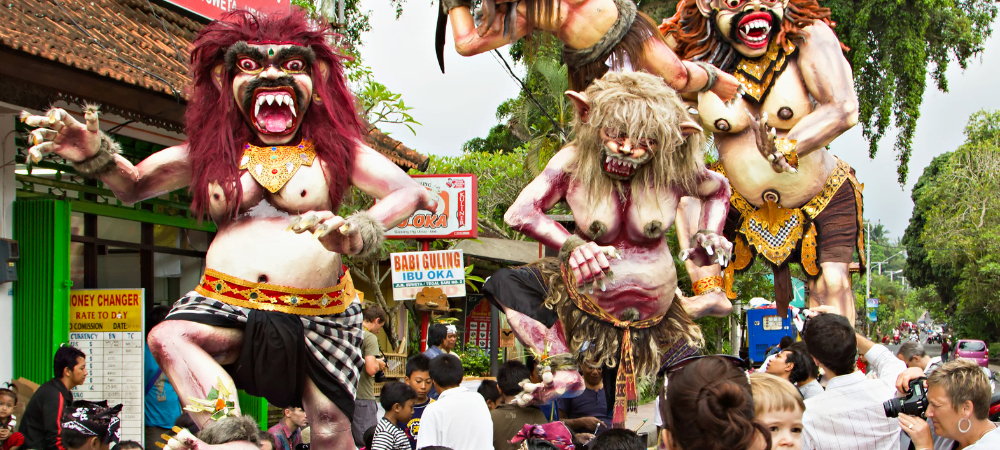
| The evening before Nyepi | Villages hold the famous Ogoh-Ogoh parades, where giant handcrafted statues are carried through the streets accompanied by music and celebration. |
| Nyepi (approximately 6am–6am) | The Day of Silence begins. Roads are empty, businesses close, flights stop, and everyone remains within their accommodation. |
| The following day | Ngembak Geni marks the end of Nyepi, with families visiting one another, asking forgiveness and welcoming the new year together. |
For visitors, this means you can experience both extremes within the space of two days. One evening is full of colour, music and celebration, while the next is defined by complete peace and stillness.
The Ogoh-Ogoh Parade: Don’t Miss It
If you’re lucky enough to be in Bali the evening before Nyepi, I always recommend making time to watch an Ogoh-Ogoh parade.
These enormous papier-mâché statues represent negative forces and are created by local communities over many weeks. Each village designs and builds its own figures, many of which are incredibly detailed and several metres tall.
As night falls, the statues are carried through the streets accompanied by traditional music, cheering crowds and an atmosphere that’s completely different from the quiet day that follows.
For many visitors, this is one of the highlights of the entire Nyepi celebration because it combines art, community spirit and Balinese tradition in a way that’s difficult to experience at any other time of year.
It’s also worth remembering that this is your opportunity to experience the festivities before the Day of Silence begins. Once Nyepi starts the following morning, everyone returns to their accommodation and the island becomes remarkably quiet.
What Actually Happens on Nyepi?
When Nyepi begins, Bali changes almost instantly.
The airport closes, roads become empty, shops shut their doors and beaches are closed to visitors. You’ll notice something that feels almost impossible on an island that’s usually full of life—there’s virtually no traffic, no music and very little movement anywhere.
Tourists are expected to remain within the grounds of their accommodation throughout the day. Hotels and private villas continue to look after their guests, but you’ll generally spend the day enjoying the facilities available where you’re staying rather than heading out to explore.
Rather than seeing these restrictions as an inconvenience, many visitors discover they’re given something increasingly rare during modern travel: an entire day with nowhere they need to be.
What It’s Like Staying in a Private Villa During Nyepi
This is probably the question we’re asked most by guests who discover their holiday overlaps with Nyepi.
The honest answer is that it depends on where you’re staying.
If you’ve booked a busy hotel because you plan to spend all day sightseeing, Nyepi can feel restrictive. But if you’re staying in a private villa, the experience is often very different.
Rather than feeling confined, many guests tell me they appreciate having a day to slow down. You might have breakfast beside your own pool, read a book you’ve been meaning to start, enjoy a swim, or simply spend uninterrupted time together without feeling like you should be rushing off to the next attraction.
Meals can usually be arranged through your villa or prepared in advance, and because you’re already in your own private space, the day feels far more relaxing than many people imagine before they arrive.
I’ve had guests who were initially disappointed to discover Nyepi fell during their holiday, only to tell me afterwards it became one of the most memorable days of their trip.
The Silence People Don’t Expect
Everyone expects Bali to be quiet on Nyepi.
What most people don’t expect is just how quiet it becomes.
Normally, Bali is full of life. You’ll hear scooters passing by, cafés playing music, people chatting, construction in the distance, and the constant rhythm of an island that’s always moving.
On Nyepi, almost all of that disappears.
Instead, you notice things that are usually hidden beneath the everyday noise—the wind moving through the trees, birds calling to one another, insects in the garden, and the sound of waves breaking in the distance.
Then, after sunset, something even more remarkable happens.
With very little artificial light across the island and no aircraft overhead, the night sky often becomes spectacular. On a clear evening, you’ll see far more stars than most visitors ever expect. It’s a side of Bali that only appears once a year, and many people tell me it’s one of their strongest memories of the entire holiday.

How to Prepare for Nyepi
A little preparation makes Nyepi much more enjoyable. Fortunately, it’s very straightforward once you know what to expect.
Here’s the checklist I usually recommend to guests staying with us:
- Buy snacks, drinks and any essentials the day before Nyepi.
- Withdraw cash in advance if you think you’ll need it.
- Download films, books, podcasts or music before the Day of Silence begins.
- Charge your phones, cameras and other devices.
- Confirm your airport transfers if you’re arriving just before or leaving just after Nyepi.
- If you’re self-catering, buy groceries the previous day as supermarkets and convenience stores will be closed.
- Make the most of the Ogoh-Ogoh parade the evening before, as it’s one of the highlights of the celebration.
The key is to think of Nyepi as part of your holiday rather than a disruption to it. Once you’ve prepared, there’s very little to worry about.
Should You Visit Bali During Nyepi?
People sometimes ask whether they should avoid travelling during Nyepi altogether.
Personally, I don’t think there’s a single right answer. It really depends on the type of holiday you’re looking for.
| Nyepi may be perfect for you if… | You may prefer another time if… |
|---|---|
| You enjoy quiet, relaxing holidays. | You’re visiting Bali for only two or three days. |
| You’re interested in Balinese culture and traditions. | Your itinerary is packed with sightseeing every day. |
| You’re staying in a private villa or resort with good facilities. | You have flights scheduled on Nyepi itself. |
| You like slowing down and switching off for a day. | You’d find spending a day at your accommodation frustrating. |
For many travellers, Nyepi becomes an unexpected highlight because it’s unlike anything they’ve experienced elsewhere. Seeing the vibrant Ogoh-Ogoh celebrations one evening and then waking up to an island that’s completely still the next day is something you’ll probably never forget.
If your dates are flexible and you’re unsure, there’s nothing wrong with planning around Nyepi. But if your trip does include it, I’d encourage you to embrace the experience rather than trying to avoid it.
Emergency Information
Make a note of emergency contact numbers for your embassy, local emergency services, and the villa’s management in case of any issues. Despite the shutdown, there is always a system in place to address emergencies.
By preparing appropriately for Nyepi and embracing its underlying principles, tourists can not only show respect for Balinese culture but also engage in a day of reflection that could be a highlight of their travel experience. It’s an invitation to slow down, introspect, and connect with the quieter side of life – a rare gift in our fast-paced world.
FAQ
What is Nyepi in Bali?
Nyepi is the Balinese Hindu New Year and the island’s annual Day of Silence. For approximately 24 hours, businesses close, roads become empty, flights stop, and everyone—including tourists—remains within their accommodation.
Can tourists leave their hotel or villa during Nyepi?
No. Tourists are expected to remain within the grounds of their accommodation throughout Nyepi. Beaches, roads and public attractions are closed, and local security officers help ensure the rules are observed.
When is the Ogoh-Ogoh parade?
The Ogoh-Ogoh parade takes place on the evening before Nyepi. This is when visitors can watch giant handcrafted statues being carried through villages as part of the Balinese New Year celebrations.
Is Bali Airport open during Nyepi?
No. Ngurah Rai International Airport closes during Nyepi, and no commercial flights arrive or depart until the Day of Silence has ended. It’s important to plan your flights accordingly.
Is Nyepi a good time to visit Bali?
It depends on the type of holiday you’re looking for. If you enjoy unique cultural experiences and don’t mind spending one day relaxing at your accommodation, Nyepi can become one of the most memorable parts of your trip.
How should I prepare for Nyepi?
Buy any food, drinks or essentials the day before, charge your devices, download entertainment if you want it, and enjoy the Ogoh-Ogoh parade before returning to your accommodation for the Day of Silence.
Will Wi-Fi and electricity still work during Nyepi?
Electricity continues as normal, and most hotels and villas provide Wi-Fi throughout Nyepi. However, it’s worth downloading anything important in advance, as internet or mobile services may occasionally be slower or more limited depending on your location.

- Welcome Back To My Villas in Bali - November 17, 2021