The Best Coffee in Seminyak: A Local Guide to Specialty Cafes
Looking for the best coffee in Seminyak? I did too. Seminyak has quietly become one of Bali’s best specialty-coffee neighbourhoods, and this is my honest guide to the cafés genuinely worth your time.
Most guides list thirty places, half of them spread across the whole island, and treat the café as a backdrop for the avocado toast. This one is different. Every pick is in Seminyak, chosen for the coffee first, with current addresses, prices in dollars, and a note on what each spot does best.
Third-wave roasters, single-origin Kintamani, latte art that means something. Most of these cafés are an easy walk or quick scooter ride from villas around Seminyak, so this is more of a stroll than a day trip. If you’re planning a full day out, our guide to the top things to do in Seminyak includes plenty of ideas for combining great coffee with shopping, beaches and local attractions.
Key Takeaways
- Seminyak is now genuinely one of Bali’s best specialty-coffee pockets, not just an Australian-style brunch scene with coffee on the side.
- Revolver Espresso, Expat Roasters and Coffee Cartel are the safe top three for coffee quality if you only have time for a couple.
- Specialty coffee here is a bargain. A flat white runs about A$3.25, well under the A$5 to A$6 you’d pay back home.
- Skip the kopi luwak. It’s an ethical and quality trap, and I explain why in the FAQ.
- Most of these cafés cluster on a few streets (Kayu Aya/Oberoi, Petitenget, Drupadi), so you can do several on foot in one morning.
| Café | Area / Street | Best for | Signature drink | Coffee price (IDR / ~A$) |
| Revolver Espresso | Kayu Aya (Oberoi), Gang 51 | Your first proper coffee, late nights | The Barrel | Flat white IDR 45K / ~A$3.65 |
| Expat Roasters | Petitenget St No.1a | Early starts, single-origin | Kintamani pour-over | Flat white IDR 40K / ~A$3.25 |
| Coffee Cartel | Jl. Lb. Sari No.8 | House-roasted + a photo | Ripple Latte | Ripple Latte IDR 55K / ~A$4.45 |
| The Koop | Jl. Drupadi No.66 | A slow, traceable morning | Farm flat white | Food from IDR 65K / ~A$5.30 |
| Titik Temu | Jl. Kayu Cendana No.1 | A quiet garden break | Gula aren latte | Specialty drinks IDR 55-85K / ~A$4.45-6.90 |
| KYND Community | Seminyak | Dairy-free, vegan bowls | Plant-milk latte | ~IDR 40-55K / ~A$3.25-4.45 |
| BRAUD Cafe | Seminyak | A French-style treat | Truffle eggs + coffee | ~IDR 40-55K / ~A$3.25-4.45 |
| BAKED Bali | Seminyak Village | Brunch plus good coffee | Best Scramble + coffee | ~IDR 40-55K / ~A$3.25-4.45 |
1. Revolver Espresso: The Seminyak Coffee Everyone Means
You’ll have read the name a hundred times before you arrive, and you’ll still walk straight past the door. Revolver is the most-recommended coffee in Seminyak, and it’s hidden down a narrow alley most first-timers miss entirely.
The reason it tops every list is simple. The espresso is consistently excellent, year after year, which is harder to pull off than it sounds in a tourist town. There’s a full brunch menu, but coffee is the point here, and the signature drink to ask for is The Barrel, their espresso-based house special.
A few practical things, because this is the café people get wrong most often.
- Address: Jl. Kayu Aya No. Gang 51, a hidden alley off Kayu Aya (Oberoi Street). Look for the small black sign at street level. This is the Seminyak Revolver, by the way. There’s a separate Canggu branch, and the two get confused constantly.
- Hours: 7am to 11pm daily. That late close makes it the only one of the big anchors you can rely on for a proper espresso after dinner.
- Prices: espresso IDR 35K (~A$2.85), flat white IDR 45K (~A$3.65). Food runs around IDR 85K (~A$6.90) for an Acai Bowl or the Shakshuka.
- The honest downsides: it’s open-air with no air conditioning, power outlets are scarce, and queues form from around 9am at weekends. Arrive before 9:30am if you want a seat and a plug.
Best for your first proper Seminyak coffee, a quick takeaway en route to the beach, or that rare late-night espresso. Skip if you need air-con and a power point for a long laptop session, because it fills up fast and the outlets vanish first.
2. Expat Roasters: Best Single-Origin and the Earliest Open
The earliest-opening specialty café in the area was started by a former chemical engineer who walked away from his career to chase Indonesian beans. Adit Prabandaru opened the doors at 6:30am, which makes Expat Roasters the answer to a question nobody else in Seminyak answers well. Where do I get a real coffee before the beach?
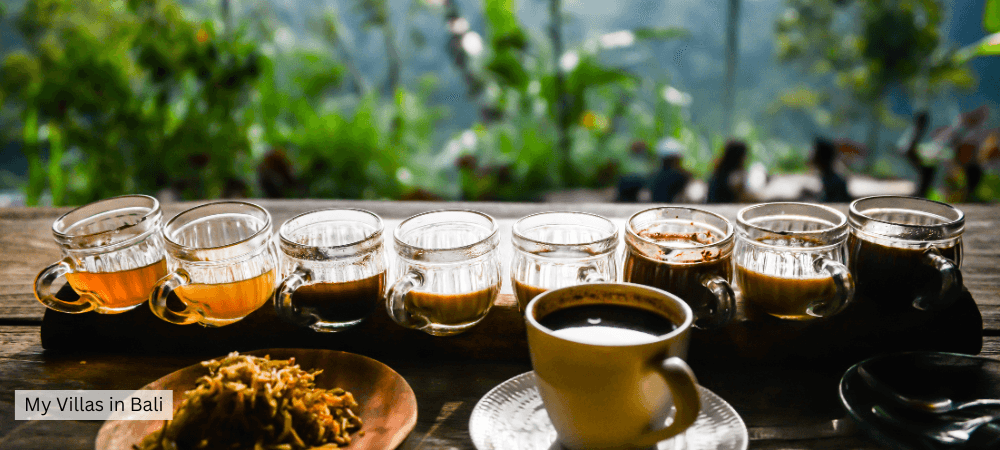
What sets it apart is the bean transparency, and this is where most guides go quiet. Every menu item lists the origin, the processing method and the tasting notes. The Kintamani Natural processed Arabica comes through as sweet rock melon and jackfruit, and it has become a benchmark for what Bali can produce. You’ll also find Sumatra Mandheling (earthy, dark chocolate) and Flores Bajawa (floral, stone fruit) as single origins. For the clearest taste of local terroir, this is the one.
Here’s what you need to know before you go.
- Address: Petitenget St No.1a, Kerobokan Kelod. Don’t let the Kerobokan Kelod label throw you. Locals just call this the Petitenget end of Seminyak.
- Hours: 6:30am to 7:30pm daily, the earliest open of any anchor. Worth knowing it closes by half-seven, so it isn’t a late option.
- Prices: the most affordable of the serious cafés. Espresso IDR 30K (~A$2.45), flat white IDR 40K (~A$3.25), and a single-origin pour-over at IDR 65K (~A$5.30) that’s genuinely exceptional value. Croissant IDR 35K, Eggs Benedict IDR 85K.
- Good to know: oat milk is available, and the quiet early hours before 9:30am make it a strong work spot.
The verdict: if you learn one thing about Bali coffee on your trip, order the Kintamani Natural pour-over here at opening, before the beach crowd lands. It’s the best-value serious coffee in Seminyak, and the first place I send any curious guest.
3. Coffee Cartel: House-Roasted Beans and the Ripple Latte
Three different guides will give you three different addresses for this place. Here’s the one that’s actually right. Honeycombers says Petitenget, others say Kerobokan Kelod, and the Legian roastery gets thrown into the mix to confuse things further.
The coffee earns the hassle. Founder Rene Lagrimas roasts single-origin beans at the Legian roastery and delivers them fresh to the Seminyak café daily, so what you’re drinking is fresher than most. The house blend rotates with the seasons, which keeps the menu changing and gives regulars a reason to come back and taste what’s landed. The signature Ripple Latte, with its latte-art waves, was a deliberate move to make specialty coffee both Instagrammable and genuinely good, without trading one for the other.
The practical details, with the address confusion finally put to bed.
- Address: Jl. Lb. Sari No.8, Kerobokan Kelod (confirmed October 2025). This is the sit-down café you want. The Legian location is the roastery, not a place to settle in with a flat white, so don’t let a search result send you there by mistake.
- Getting there: it sits a little further from the Kayu Aya tourist centre, but it’s only about a 10-minute walk from Expat Roasters, which sets up a neat two-café Petitenget morning.
- Prices: Ripple Latte IDR 55K (~A$4.45), plus a full all-day breakfast menu if you want to make a proper sit-down meal of it.
If you want the photo and the coffee to both be good, this is your stop. Pair it with Expat Roasters, ten minutes up the road, for an easy Petitenget morning that covers sourcing and roasting in one walk.
4. The Koop Roaster and Cafe: Farm-to-Cup, From Their Own Farm
Plenty of cafés buy local beans and call it farm-to-table. The Koop literally owns the farm. Founder Yukiko Onishi moved from Japan to Bali and took the unusual step of buying and running her own coffee farm, DiBON, up in Menggani village.
That full vertical integration is rare even in specialty coffee globally, and you can taste it. The DiBON Washed Arabica and the God Island Blend carry a sharp citrus note that cuts through the milk, a direct signature of the high-altitude volcanic soil. The space matches the ethos. It’s wooden, white-washed and lived-in rather than styled for a photo, with woven baskets and local pottery instead of neon signs. The banana bread is dense and moist exactly as banana bread should be, simple and unpretentious, none of the cake-like nonsense you get elsewhere.
What to plan around here.
- Address: Jl. Drupadi No.66, Seminyak, on a quiet neighbourhood street away from the main drag.
- Hours: 7am to 3pm Monday to Saturday, 9am to 3pm Sunday. Note that 3pm close clearly. This is a morning and early-afternoon café only, so plan ahead. No air-con, and it’s a small two-floor space, so it can feel snug at peak times.
- Prices: very kind on the food. Full Breakfast Plate, Egg Florentine and Smashed Avo & Feta Toast are all IDR 65K (~A$5.30), which is a proper sit-down breakfast for the price of a flat white back home. Pair one with a coffee and the banana bread.
Best for a slow, authentic morning and the most traceable cup in Seminyak. Sit upstairs. Skip if you’re a late riser or want afternoon coffee, because the doors shut at 3pm and won’t reopen.
5. Titik Temu Coffee: A Garden Hideaway and a Palm-Sugar Latte
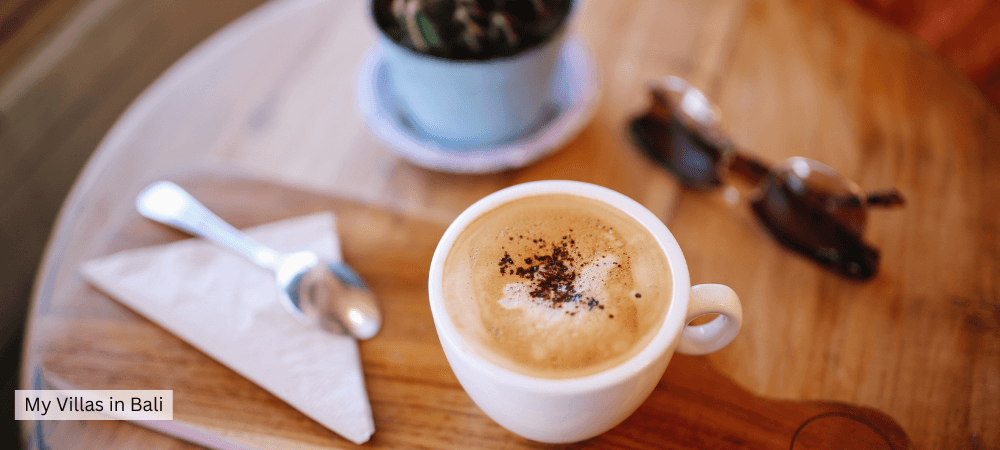
Want the most “Bali” coffee on this list without the queues? Tucked into a garden off Kayu Cendana, Titik Temu is where I send guests who want a peaceful table and something distinctly local. Order the gula aren latte, made with palm sugar.
It’s a specialty roastery with branches across Bali, Jakarta and Medan, so the quality is consistent and dependable. The gula aren latte is the one to try, nutty and sweet without any sourness. I’ll be honest, though. As a small chain it’s a touch less unique than the independent roasteries, and it doesn’t give you the tasting-note transparency you get at Expat. The draw here is the consistency and the setting rather than the bean story.
The essentials before you wander over.
- Address: Jl. Kayu Cendana No.1, Uma Seminyak. It’s a genuine hidden gem in a garden setting off the main street.
- Hours: 8am to 8pm, Monday and Wednesday to Sunday. Closed Tuesdays, so don’t waste the trip. Those are longer hours than most independents manage.
- Working and prices: the garden is quieter mid-morning and midday, which makes it a calmer work spot once Revolver and Expat fill up. Signature specialty drinks sit in the IDR 55K to 85K range (~A$4.45 to A$6.90).
The verdict: this is the peaceful one. Come when the Petitenget cafés are heaving and you want a quiet garden table and a sweet, local palm-sugar latte. Just not on a Tuesday.
6. KYND Community: The Vegan Spot for Dairy-Free Coffee
If you’re dairy-free, you’ll know the routine. You ask at every counter whether they have oat milk and hope for the best. At KYND you can finally stop asking, because the whole place is vegan and every plant milk is covered.
It’s a fully vegan concept café and store, with an iconic pink interior and a menu of healthy bowls and smoothies alongside the coffee. You walk through the concept shop to reach the café, and the bowls and smoothies come out fresh and genuinely good. The wifi holds up well enough for a casual work session, too. I’ll be straight with you, though. Coffee is secondary to the food and lifestyle brand here, and it can feel more like a tourist attraction than a specialty-coffee destination. I’m including it for what it genuinely does best, not for the best espresso in town.
It’s also the natural place to settle the dairy-free question for the whole neighbourhood. Expat Roasters carries oat milk, Sisterfields does an almond latte, and most independents stock at least one option, though it’s always worth confirming at the counter. An oat-milk add-on usually runs about IDR 10K to 15K (~A$0.80 to A$1.20), so it barely moves the bill.
Best for dairy-free and vegan travellers, a colourful brunch bowl, and a relaxed laptop session. Skip if you came to Seminyak chasing a serious single-origin pour-over, in which case Expat or The Koop is your answer.
7. BRAUD Cafe: The New French-Inspired Arrival
Want something the guidebooks haven’t caught up to yet? BRAUD opened in late 2025, so it post-dates almost every list you’ll find online, and it brings a French slant to a scene that’s overwhelmingly Australian in style.
It’s a French-inspired bakery-café, which is a genuine break from the norm here. The Truffle Scrambled Eggs are the standout, backed up by buttery croissants and pain au chocolat that come out of the oven through the morning. It opens early, so it slots in nicely before a beach day or as a first stop on a slow morning. Being new, it hasn’t built much of a reputation yet, and there’s little out there on its wifi or work suitability, so I’d treat it as a treat-and-brunch stop rather than a base for the laptop.
On price, expect the usual Seminyak specialty range of roughly IDR 40K to 55K (~A$3.25 to A$4.45) for a coffee, with the pastries and truffle eggs adding the bulk of the bill. If you’ve already ticked off Revolver and Expat and fancy something different, come here for the truffle eggs and a croissant. It’s the freshest face on this list, and a nice change of register.
8. BAKED Bali: Pastries and a Proper Scramble in Seminyak Village
Here’s a second new-for-2025 tip, this time for the brunch-plus-coffee crowd. BAKED opened in October 2025, right in Seminyak Village, which is a central and very walkable micro-area you can reach on foot from most Seminyak villas.
It’s a stylish bakery-café with a strong social following, and the signature is the cult “Best Scramble” eggs alongside a counter of fresh pastries. The coffee gets a genuine nod in reviews, too, which is more than you can say for a lot of the photogenic newcomers that lean entirely on the interior. I’ll keep it accurate to the angle, though. This one is bakery and brunch-led, so come for the scramble and the pastry morning with a solid coffee on the side, not for a single-origin pilgrimage. Prices sit in the usual Seminyak specialty band, around IDR 40K to 55K (~A$3.25 to A$4.45) for a coffee, with the food where the spending really happens.
The verdict: the stylish brunch newcomer. Come for the scramble and the pastries, stay for a genuinely good coffee, and you’re already in the middle of Seminyak for whatever you’ve got planned next.
If You Only Have One Morning: The Seminyak Coffee Crawl
Short on time? Here’s how to taste the best of Seminyak’s coffee in a single morning, entirely on foot. It works because these cafés cluster into three walkable pockets, and the whole route is under about 30 minutes of actual walking.
- 6:30 to 7:30am, Expat Roasters (Petitenget St No.1a). Order the Kintamani Natural pour-over (IDR 65K, ~A$5.30). It’s the clearest expression of local terroir, and the place is calm before the beach crowd arrives.
- About a 10-minute walk south to Coffee Cartel (Jl. Lb. Sari No.8). Order the Ripple Latte (IDR 55K, ~A$4.45). This is your Instagram cup.
- About 8 minutes on to The Koop (Jl. Drupadi No.66). A flat white from their own DiBON farm, paired with the banana bread. Sit upstairs.
- Optional 5-minute extension to Titik Temu (Jl. Kayu Cendana No.1) for a gula aren latte, the most local finish of the four.
The clusters break down into Kayu Aya/Oberoi (Revolver), Petitenget (Expat, Coffee Cartel), and Drupadi/Kayu Cendana (The Koop, Titik Temu). Most villas around Seminyak put you within a short walk or quick scooter ride of at least one of these pockets, so this can genuinely be a before-breakfast stroll rather than a planned excursion.
After your morning coffee, why not spend the afternoon relaxing at one of the best beach clubs in Seminyak before heading out for dinner.
If you do nothing else coffee-wise on your trip, do this crawl on your first jet-lagged morning. You’ll have tasted sourcing, roastery and farm-to-cup before most people are even awake.
Seminyak Coffee FAQ
What is the most famous coffee in Bali?
Kintamani Arabica. It’s grown in the northern highlands between 1,200 and 1,700 metres on volcanic soil, intercropped with orange trees that lend it a citrus-bright character. In 2008 it became the first Indonesian coffee to receive Geographical Indication protection, the equivalent of an EU PDO. Order it as a single origin at Expat Roasters.
Is kopi luwak (civet coffee) worth trying in Bali?
No, on both ethics and quality. PETA investigations found that nearly all commercial kopi luwak in Bali comes from caged, force-fed civets despite “wild-sourced” labels, and the coffee is often over-roasted to mask defects. A specialty pour-over costs a similar amount and tastes far better. No credible Seminyak café serves it.
How much does coffee cost in Seminyak (in dollars)?
At roughly 12,300 IDR to A$1 (June 2026), an espresso runs about A$2.45 to A$3.25, a flat white or latte about A$3.25 to A$4.90, and a single-origin pour-over about A$4.90 to A$6.50. That’s well under what you’d pay for specialty coffee back home.
What’s the difference between specialty coffee and regular Bali coffee (kopi Bali)?
Specialty coffee scores 80 or above on the SCA scale, judged on bean quality, processing and preparation. Cafés like Expat Roasters and The Koop roast single-origin Arabica, usually Kintamani, on-site. Kopi Bali is typically a robusta-based dark roast served with condensed milk, rich and sweet but with less terroir complexity. Both are worth a try.
Which Seminyak cafes are best for working with a laptop?
Expat Roasters and Revolver before 9:30am, when the wifi is strongest and the corner seats with power outlets are still free. Titik Temu’s garden is quieter around midday, and KYND has reliable wifi. Avoid the peak brunch window of 10am to 1pm, when seats vanish and outlets become impossible to find.
Is Revolver Espresso in Seminyak or Canggu?
Both, and they’re separate branches. The Seminyak one is at Jl. Kayu Aya No. Gang 51, down a hidden alley off Kayu Aya (Oberoi Street), open 7am to 11pm daily. When a “best coffee Seminyak” list mentions Revolver, this is the one it means.
Are there non-dairy milk options (oat/almond)?
Yes, and increasingly so. KYND Community is fully vegan with every milk covered, Expat Roasters has oat, and Sisterfields does an almond latte. Most independents carry at least one option, though it’s worth confirming at the counter. An oat-milk add-on usually costs about A$0.80 to A$1.20 extra.

- Welcome Back To My Villas in Bali - November 17, 2021